 Americas Rugby News Rugby news from across the Americas!
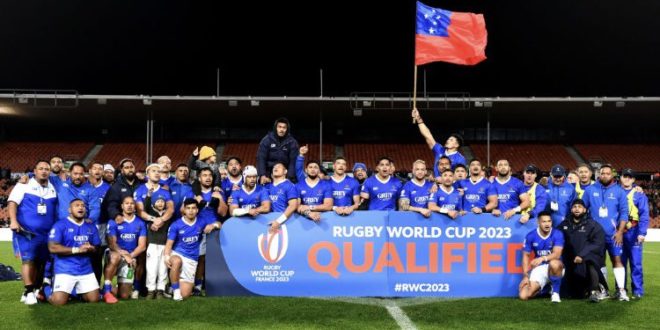
Former Samoa captain Chris Vui was handed a four-year ban from rugby after testing positive for the banned anabolic steroid nandrolone. The test that flagged him was an out-of-competition test—not during the 2023 Rugby World Cup in France, but he mysteriously disappeared from the tournament after playing for Samoa against Argentina and Chile.
The player’s system contained elevated levels of 19-norandrosterone at nearly four times the legal limit. Vui was representing Manu Samoa at the 2023 Rugby World Cup when he was provisionally banned by World Rugby on September 27, 2023, causing him to leave the tournament.
Vui’s legal team appealed the ban, arguing that the positive result was caused by contaminated supplements and raising procedural complaints regarding the testing process. Both the World Rugby Judicial Committee and the Court of Arbitration for Sport (CAS) rejected the appeal, stating there was insufficient evidence. The player’s four-year suspension was officially backdated to August 1, 2023.

 WORLD CUP CHEATING BY CHRIS VUI WORLD CUP CHEATING BY CHRIS VUI |
Chris Vui played in two matches at the 2023 Rugby World Cup for Samoa before his provisional suspension took effect. As the co-captain of the squad, he was able to take the field for the first half of Samoa’s pool stage campaign. Against Chile on September 16, 2023, Vui co-captained and started in the second row, playing the full match to help Samoa secure a 43-10 victory. Against Argentina on September 22, 2023, he played in this physical encounter, which Samoa lost 19-10.
Vui was born and raised in Auckland, New Zealand, rather than Samoa. He played 140 minutes against South American opponents at Rugby World Cup 2023. He was provisionally suspended before Samoa’s third match against Japan, abruptly ending his World Cup participation.
Legally, he is considered to have committed an intentional doping violation. Under global anti-doping regulations, any athlete who tests positive for a banned substance is held strictly responsible for what is found in their body. For a substance like nandrolone, an automatic four-year ban is applied unless the athlete can definitively prove the exposure was accidental or completely outside their control.
Vui argued that he did not cheat knowingly and that his positive test was caused by a contaminated supplement. He even went as far as submitting polygraph test results and character references to prove his honesty. Both World Rugby and the Court of Arbitration for Sport (CAS) rejected his explanation, declaring his defense too speculative and too lacking in hard evidence. Because he could not prove how the steroid entered his system, the courts ruled the violation as legally intentional, cementing his four-year ban. In short, sports law formally recognizes Chris Vui’s case as a definitive doping violation.
Chile and Argentina receive no retroactive points, compensation, or changes to their match results under World Rugby rules. While Chris Vui’s violation took place before and during his matches against them, the official results of those tournament games stand as originally played. Under World Rugby anti-doping regulations, a team faces disqualification or match forfeiture only if more than two players on the team are found to have committed a doping violation during the same tournament. Because Vui was the only member of the Manu Samoa squad to fail a drug test, the overall team was not sanctioned.

| WORLD RUGBY FAIL SOUTH AMERICA AGAIN |
The historical grievance from the 1999 Rugby World Cup remains a massive point of debate in international rugby. The scandal, famously dubbed “Grannygate,” exposed that both Wales and Scotland fielded ineligible, foreign-born players during the tournament—including in their respective matches against Argentina and Uruguay.
Under the International Rugby Board (IRB) rules at the time, a player could only represent a country if they were born there, had a parent or grandparent born there, or completed a 36-month residency period. Both teams bypassed these rules using false ancestry claims. In the opening match on October 1, 1999, Wales defeated Argentina 23-18 while fielding Shane Howarth and Brett Sinkinson—both New Zealanders who claimed to have Welsh grandparents. A subsequent investigation revealed these grandparents did not exist or had no ties to Wales.
On October 8, 1999, Scotland defeated Uruguay 43-12 while fielding English prop Dave Hilton, who claimed Scottish ancestry through his grandfather. The investigation later proved his grandfather was actually born in England.
When the “Grannygate” scandal officially broke in March 2000, the tournament was already over. The IRB chose not to retroactively strip points or disqualify Wales and Scotland. The players were simply barred from international duty until they properly qualified via residency. By contrast, modern regulations have penalized Tier 2 and Tier 3 nations far more harshly for similar administrative oversight.
In 2018, Spain, Romania, and Belgium were deducted massive amounts of points and disqualified from the 2019 World Cup for fielding ineligible players. In 2022, Spain was disqualified from the 2023 World Cup for a single administrative oversight regarding the residency passport of Gavin van den Berg.