 Americas Rugby News Rugby news from across the Americas!
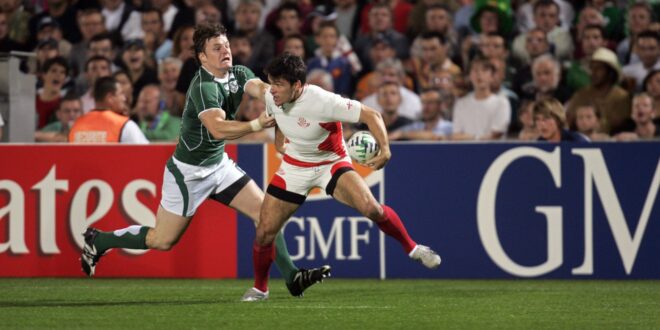
Ireland completed a lucky escape to beat Georgia 14–10 on September 15, 2007, in Bordeaux, France. The Rugby World Cup 2007 pool match stands as one of the sharpest wake-up calls in tournament history, pitting a Six Nations powerhouse against a rising Tier 2 country whose structural exclusion from regular Tier 1 opportunities continues nearly two decades later.
Heading into Rugby World Cup 2007, the Ireland and Georgia occupied entirely different stratospheres of World Cup history. Ireland had competed in every edition since the inaugural 1987 tournament, reaching the quarter-finals in 1987, 1991, 1995, and 2003, while suffering a playoff exit in 1999. Georgia, by contrast, had debuted at the 2003 Rugby World Cup in Australia, losing vs England, South Africa, Samoa, and Uruguay.
Before meeting at Stade Chaban-Delmas, both sides had already shown early signs of how Pool D would unfold. Ireland opened their campaign in Bordeaux on September 9 with an inept 32–17 victory over Namibia, securing a four-try bonus point win but looking disjointed and fragile against a heavy underdog. Two days later in Lyon, Georgia made their 2007 bow against Argentina, holding Los Pumas to a 6–3 halftime deficit before tiring late in a 33–3 defeat.
Eddie O’Sullivan named a full-strength Irish side expecting routine progression, while Georgia rotated heavily to target their upcoming clash with Namibia. Yet from the opening exchanges, the Lelos matched Ireland’s physicality at the collision. Rory Best scored from a 17th-minute lineout maul which Californian-born Ronan O’Gara converted.
Yet, further first-half scoring was grim for Ireland. Just before the interval, a sweeping Georgian break forced flanker David Wallace into a cynical breakdown infringement, resulting in a yellow card and a Merab Kvirikashvili penalty that trimmed the halftime margin to 7–3.
Five minutes into the second half, Bordeaux erupted. Winger Giorgi Shkinin anticipated a floating Peter Stringer pass aimed at Brian O’Driscoll, plucked it out of the air, and raced nearly two-thirds of the length of the field to score under the posts. Kvirikashvili’s conversion handed Georgia a stunning 10–7 lead.
Ireland regained their composure through sustained forward pressure, and fullback Girvan Dempsey crossed in the left corner in the 55th minute before O’Gara nailed the touchline conversion to make it 14–10.
The final quarter became an agonizing siege on the Irish line, culminating in a late Georgian surge over the whitewash that was ruled held up by the TMO after NO. 8 Denis Leamy wedged himself beneath the ball.
Across six all-time Test meetings, Ireland has maintained an unbeaten 6–0 record against Georgia, though none came close to matching the drama of 2007. Prior to Bordeaux, Ireland routed Georgia 70–0 in 1998 and 63–14 in 2002 in Rugby World Cup qualifying. Following 2007, Ireland recorded comfortable home victories in Dublin, winning 49–7 in 2014 and 23–10 in 2020 and won 34–5 in Tbilisi in 2025.
In subsequent Rugby World Cups from 2011 to 2023, both teams followed consistent trajectories without crossing paths again. Ireland topped their pools in 2011, 2015, and 2023, highlighted by famous pool victories over Australia in 2011 and South Africa in 2023, yet was eliminated at the quarter-final stage in all four tournaments, losing to Wales in 2011, Argentina in 2015, and New Zealand in 2019 and 2023.
After claiming their maiden World Cup win against Namibia in Lens in 2007, Georgia beat Romania in 2011, achieved a landmark third-place pool finish with wins over Tonga and Namibia in 2015, defeated Uruguay in 2019, and drew 18–18 with Portugal during a winless 2023 campaign.
Nineteen years on from the battle of Bordeaux, the structural divide between Ireland and Georgia remains unchanged. Traditional powers have continued to resist expanding the Six Nations, leaving Europe without a unified continental championship and confining Georgia to the second-tier Rugby Europe Championship.
The launch of the Nations Championship cemented the tier split: Ireland competed in the top-flight division, facing southern hemisphere opposition including a July clash against Japan in Newcastle, Australia rather than in Japan itself, while Georgia was excluded from the top tier altogether to complete in the secondary World Rugby Nations Cup. The Lelos went undefeated against Uruguay, Samoa, Chile, Canada, Tonga, and the USA.
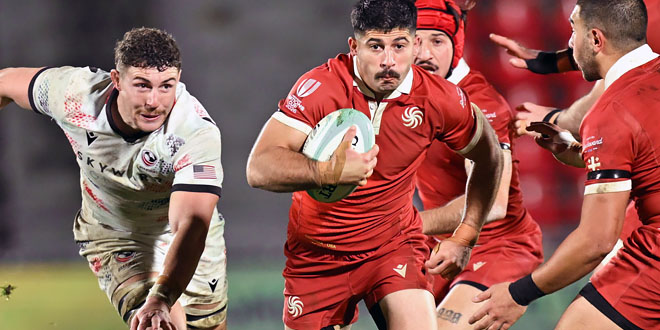
Ireland and Georgia will both be teams to follow at the expanded 24-team competition at Rugby World Cup 2027 in Australia. The new Round of 16 format awaits the top two teams in each pool plus the four best third-place finishers.
Ireland has been drawn into Pool D alongside Scotland, Uruguay, and Portugal. Georgia is in Pool B together with Italy, Romania and defending champions South Africa. On paper, Italy vs Georgia is a pivotal clash. It will be played in Newcastle on October 16, 2027.